
Pennsylvania Criminal Records
Pennsylvania criminal records are public documents held by state and county agencies across all 67 counties. The Pennsylvania State Police maintain the central criminal history repository through the PATCH system, while the courts manage case files through the Unified Judicial System. You can search Pennsylvania criminal records online at no cost through the UJS Portal, or request a certified background check for a fee through PATCH. This guide covers every major tool and agency you need to find criminal records in Pennsylvania.
Pennsylvania Criminal Records Quick Facts
Pennsylvania Criminal Records and the PATCH System
The Pennsylvania Access to Criminal History system, known as PATCH, is the state's official portal for criminal background checks. It is run by the Pennsylvania State Police and is the primary way to get a certified criminal history record in Pennsylvania. You reach the system at epatch.pa.gov. A standard check costs $22. If you need a notarized copy, the total is $27. Volunteer requests are free but cannot be notarized.
PATCH accepts two types of users. Registered users are companies and agencies with routine needs. They set up accounts for bulk processing. Non-registered users are individuals making one-time or occasional requests who can search without creating a permanent account. Non-registered users can run up to 10 checks in a single session. About 85% of searches return a "No Record" result right away by email. If the name matches records in the database, the request goes into "Under Review" status and can take two to four weeks for a manual review.
The PA.gov criminal history services page explains all check types and fees in one place. PATCH reports show the subject's name, date of birth, offense descriptions, statutory citations, dispositions, and sentence information. The system only covers Pennsylvania law enforcement records. It does not include federal records, records from other states, juvenile records, or expunged and sealed records. The PATCH helpline is available at 1-888-QUERY-PA during business hours.
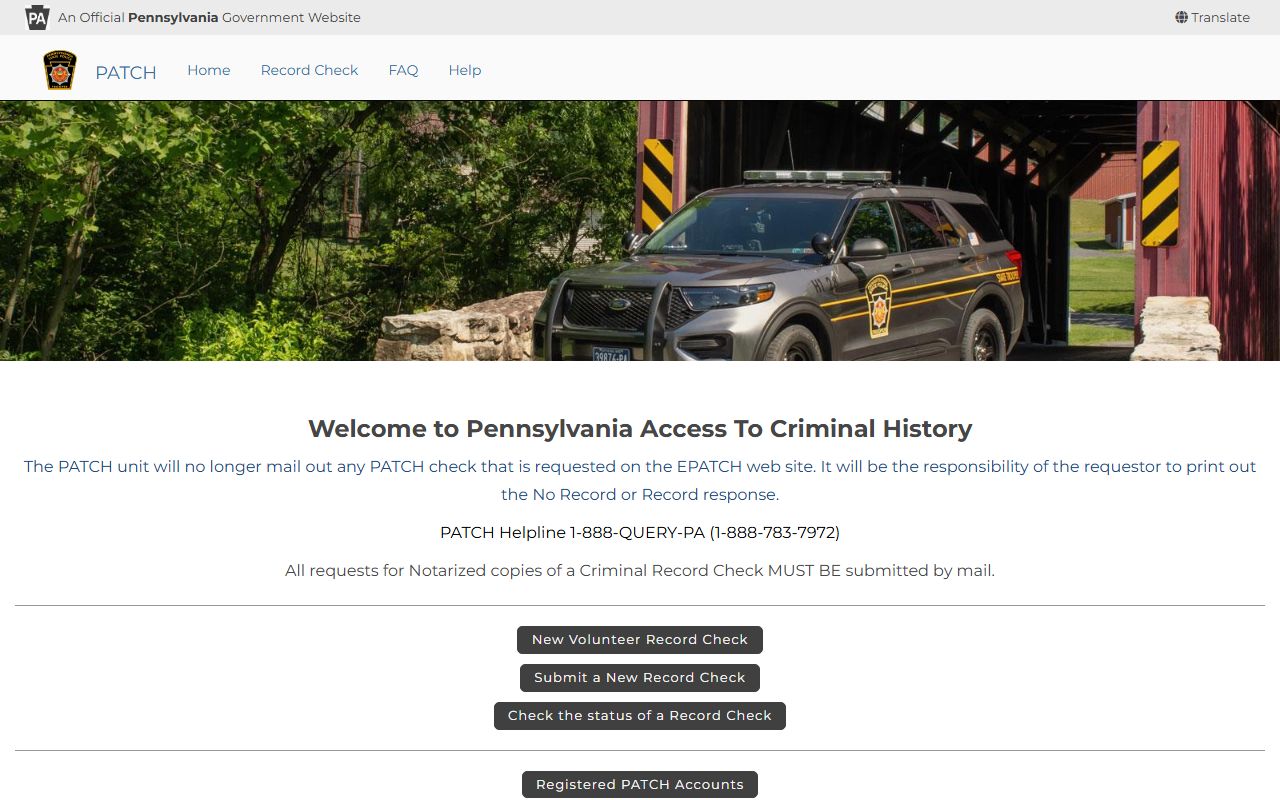
The PATCH portal at epatch.pa.gov is the official starting point for criminal history background checks in Pennsylvania. The system is maintained by the Pennsylvania State Police and is updated from court and law enforcement reports statewide.
Note: PATCH covers only Pennsylvania state records and does not include federal court records or records from other states.
PA.gov Criminal History Services and Background Check Options
The official Pennsylvania government portal at PA.gov gives a clear overview of all background check options. Three forms cover the main check types. Form SP 4-164 is for standard criminal history requests. Form SP 4-164A covers volunteer requests, which are free but cannot be notarized. Form SP 4-170 is for Individual Access and Review, meaning you want to see what the State Police have on file about you. The Individual Access form requires mailing fingerprints and costs $20.
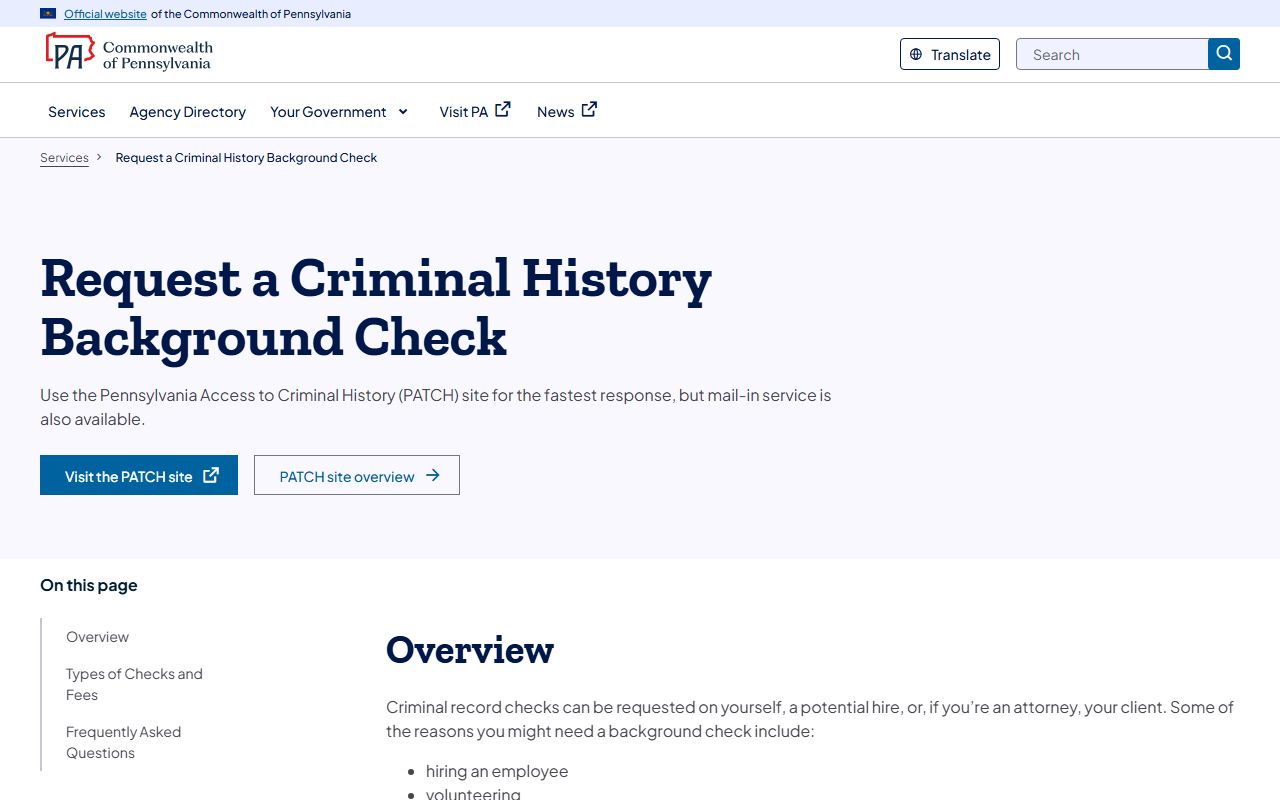
The PA.gov services page lays out each background check type, the form numbers, costs, and how results are delivered for Pennsylvania criminal history requests.
Payment for online requests is by credit card. Mail-in requests require a certified check or money order made out to "Commonwealth of Pennsylvania." Personal checks are not accepted. Send paper requests to: Pennsylvania State Police Central Repository-164, 1800 Elmerton Avenue, Harrisburg, PA 17110-9758. The CHRIA Act (18 Pa.C.S. Chapter 91) governs how criminal history information is collected and shared across Pennsylvania agencies.
Free Pennsylvania Criminal Records Search via UJS Portal
The Unified Judicial System Web Portal at ujsportal.pacourts.us gives free public access to court case information across all of Pennsylvania. You can search by participant name, docket number, OTN (Offense Tracking Number), citation number, or complaint number. The portal covers Magisterial District Courts, Courts of Common Pleas, Superior Court, Commonwealth Court, and the Pennsylvania Supreme Court.
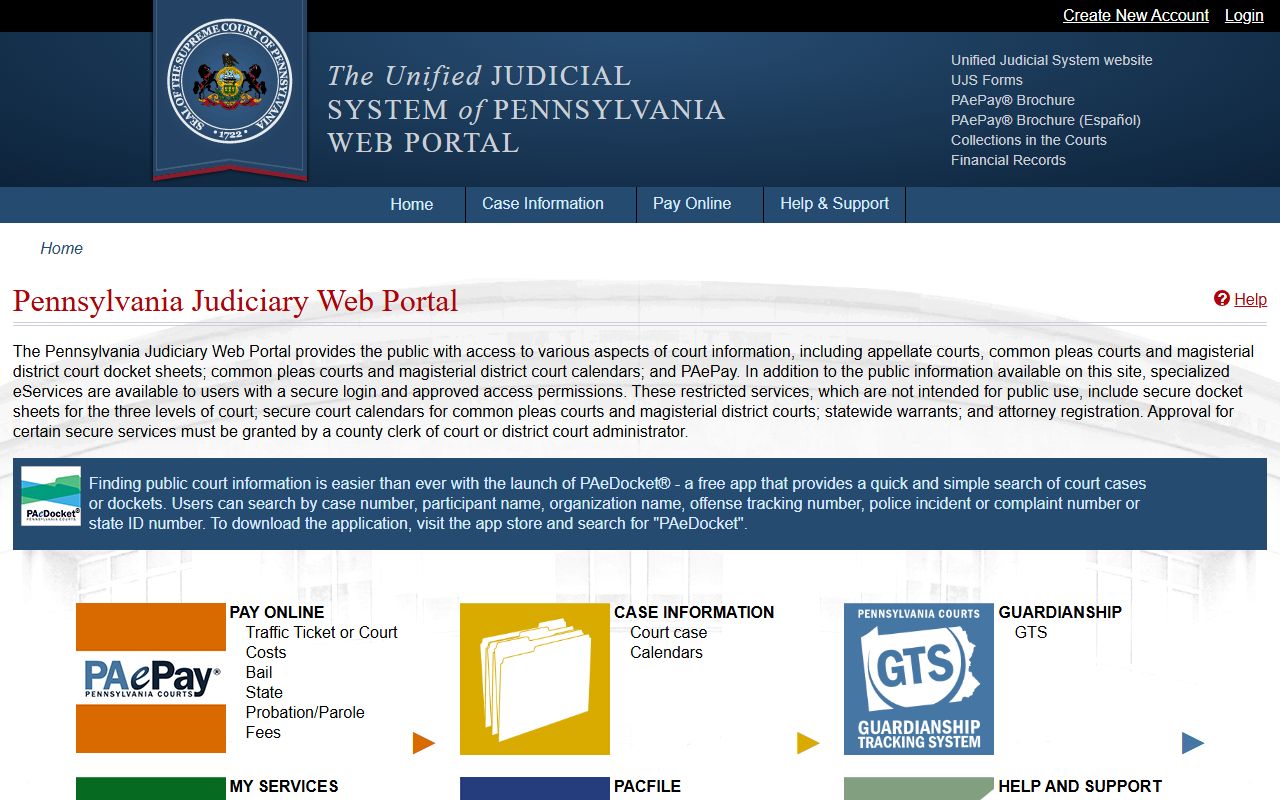
The UJS Portal provides free statewide access to Pennsylvania court case records. The system is run by the Administrative Office of Pennsylvania Courts and covers all court levels.
Through the UJS Portal, you can find case status, court dates, charges filed, dispositions, sentencing details, attorney names, and judge assignments. Docket entries are updated within 24 to 48 hours of court proceedings. The PAeDocket mobile app offers the same search on iOS and Android devices. Docket numbers follow the format CP-XX-CR-XXXXXX-YYYY, where XX is the county code and CR marks a criminal case.
The portal has real limits. Juvenile cases do not appear. Protection from Abuse filings are not viewable. Expunged and sealed cases are removed from public results. Actual documents such as complaints and motions are not available through the public portal. To get copies of documents, you must contact the courthouse directly or visit in person. Public access terminals at most Pennsylvania courthouses let you search without internet access.
Note: The UJS Portal shows court records only, not arrest records held solely by law enforcement agencies.
DOC Inmate Locator for Pennsylvania Criminal Records
The Pennsylvania Department of Corrections runs a free inmate and parolee search tool at inmatelocator.cor.pa.gov. The database updates daily and shows current and former state prison inmates. You search by last name or DOC number. Adding a first name helps narrow results for common surnames.
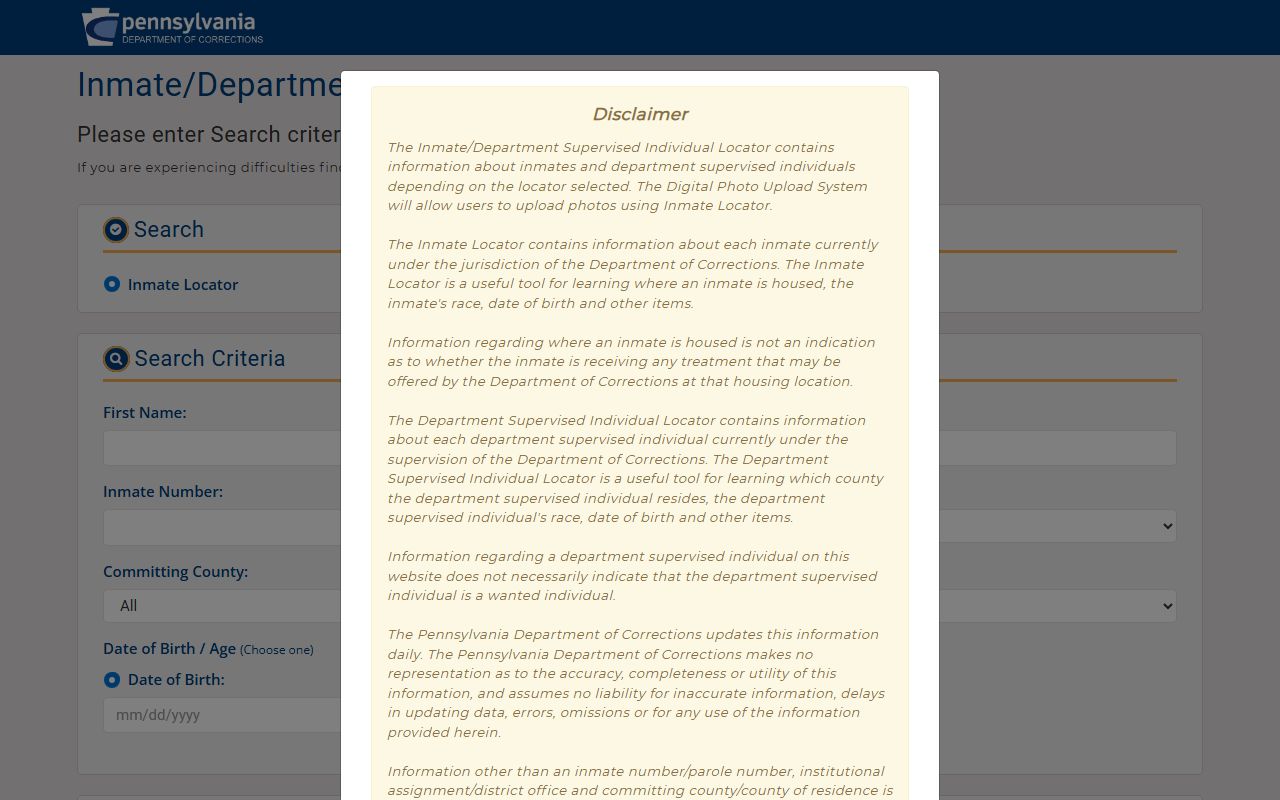
The DOC Inmate Locator at inmatelocator.cor.pa.gov is updated daily and covers individuals currently in state correctional institutions as well as parolees under supervision.
Results include the inmate's name, aliases, date of birth, race, physical description, current facility, committing county, sentence date, and parole eligibility date. The locator does not include people in county jails. Individuals serving sentences under two years stay in county facilities and do not appear here. It also does not include people on probation (only parole), federal inmates, or individuals in other states' facilities. Former inmates remain in the database for about one to two years after release. Contact DOC by email at ra-contactdoc@pa.gov or by phone at 717-728-2573 for technical help.
Pennsylvania Right-to-Know Law and Criminal Records Access
Pennsylvania's Right-to-Know Law (Act 3 of 2008) gives the public access to government records, including many criminal records. The Pennsylvania Office of Open Records at openrecords.pa.gov oversees this law. Adult conviction records, court dockets, case files, criminal court proceedings, sentencing information, incarceration records, sex offender registry information, and police blotters are all public under this law.
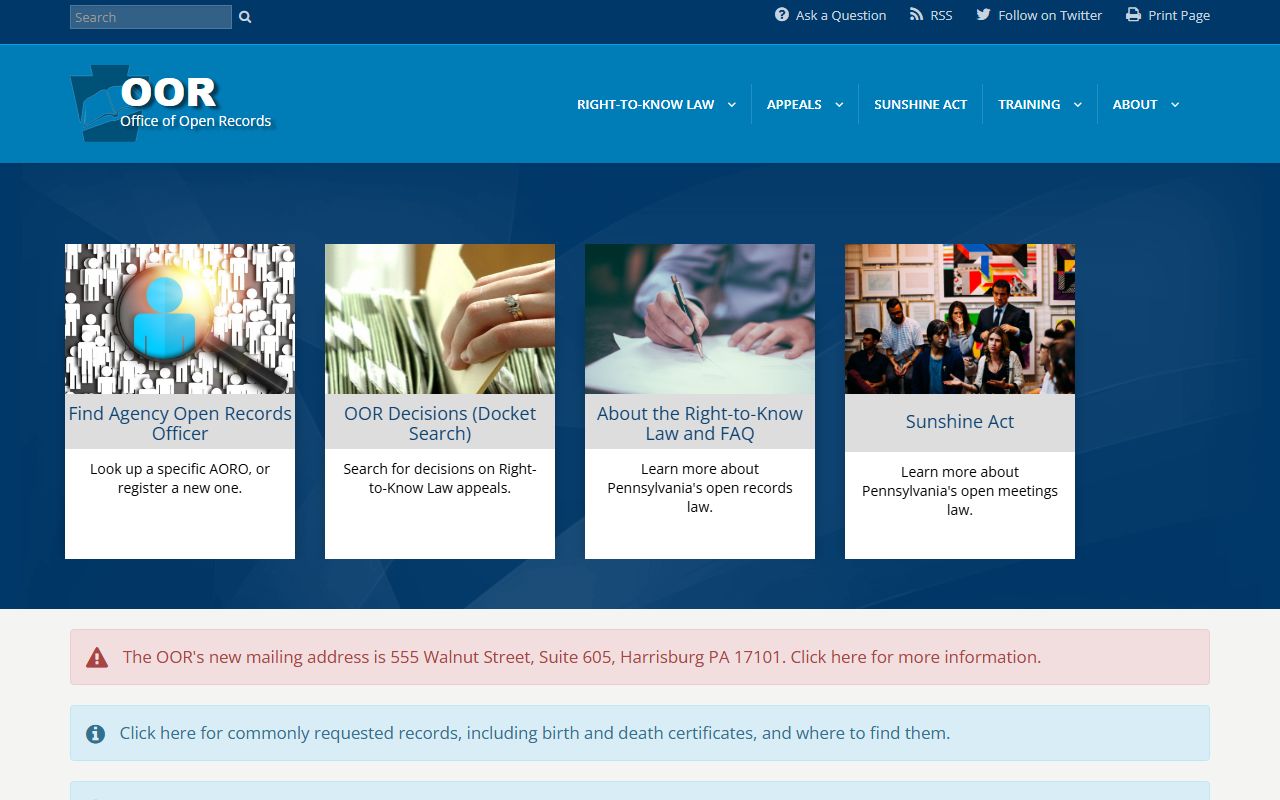
The Office of Open Records in Harrisburg handles appeals of denied public records requests and provides guidance on accessing Pennsylvania government records including criminal case files.
To request records, submit a written request to the agency's Open Records Officer. The agency must respond within 5 business days. Photocopies cost $0.25 per page. Appeals of denied requests must be filed within 15 business days. Criminal records appeals go to the District Attorney of the county where the records are held, not to the Office of Open Records directly. The Office is located at 333 Market Street, 16th Floor, Harrisburg, PA 17101 and can be reached at (717) 346-9903.
Records related to ongoing investigations are exempt from disclosure under Section 708(b)(16) of the Right-to-Know Law. Once an investigation ends, those records may become public. Personal medical information, minor children's data, and certain financial account numbers may be redacted from records that are otherwise public. The law applies to state and local agencies across all 67 Pennsylvania counties.
Pennsylvania Board of Pardons and Record Relief
The Pennsylvania Board of Pardons reviews applications for clemency and makes recommendations to the Governor. A pardon from the Governor restores civil rights such as voting and firearm possession, but it does not automatically seal or expunge a criminal record. Pardon recipients must file a separate court petition to seek expungement under 18 Pa.C.S. § 9122.
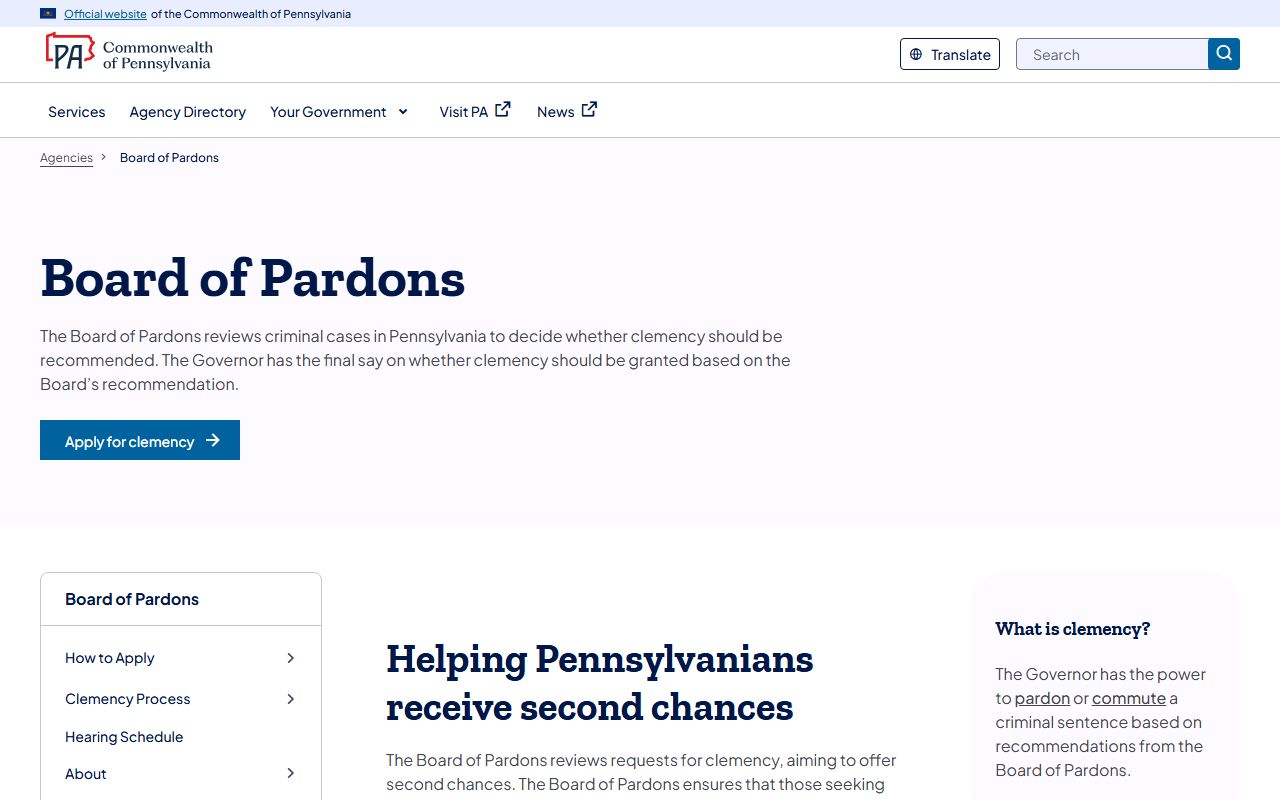
The Board of Pardons at bop.pa.gov accepts applications for pardons and commutations. The five-member board holds public hearings in Harrisburg and votes on whether to recommend clemency to the Governor.
The application process has eight steps and takes two to four years from start to finish. The application fee is $8 to purchase materials, plus a $25 non-refundable processing fee. Applicants must have completed their full sentence including all probation and parole supervision, and must have paid all fines, costs, and restitution. A minimum wait of five years after conviction applies for most offenses. In 2023, the Board merit-reviewed 1,038 applications and held hearings for 520 of them. The Board requires a three-of-five vote to recommend a pardon to the Governor. The Board's address is 333 Market Street, 15th Floor, Harrisburg, PA 17126.
Megan's Law Sex Offender Registry in Pennsylvania
Pennsylvania's sex offender registry is free to search at pameganslaw.state.pa.us. The registry is run by the Pennsylvania State Police under Megan's Law, which was enacted in 1995. You can search by offender name, county of residence, city, ZIP code, or a geographic radius around any address.
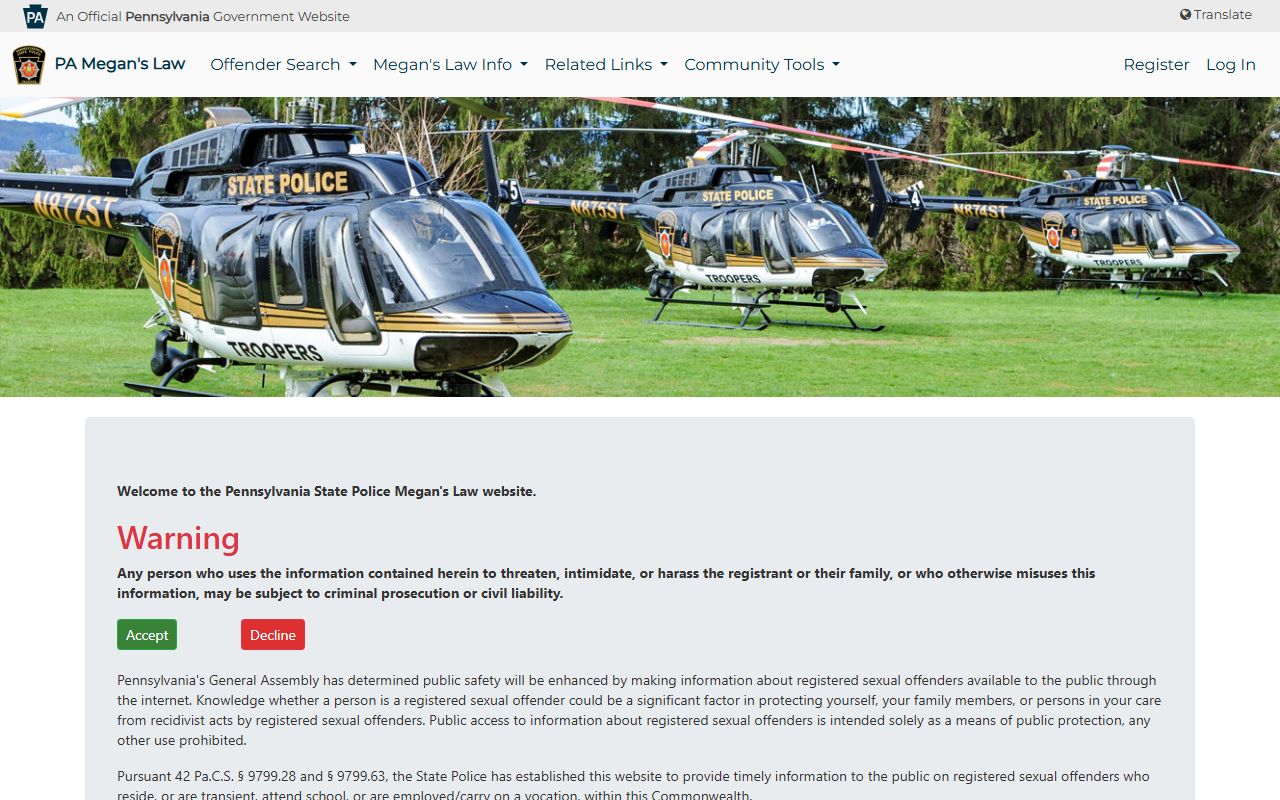
The Pennsylvania Megan's Law website lets anyone search the state sex offender registry by name, location, or proximity. Offender profiles include photos, current addresses, offense details, and vehicle information.
The registry uses three tiers based on offense severity. Tier I offenders register for 15 years with annual verification. Tier II offenders register for 25 years with verification every six months. Tier III offenders register for life with quarterly verification. Public profiles include the offender's full name, aliases, current address, photo, offense details, physical description, date of birth, and vehicle information. An email notification system lets residents sign up for alerts when a registered offender moves into their area. The Megan's Law mobile app is also available for iOS and Android.
Failure to register is a criminal offense under 18 Pa.C.S. § 4915.1. A first failure-to-register offense is a third-degree felony. Subsequent offenses are second-degree felonies. Offenders must report any address change within 48 hours.
Pennsylvania Criminal Justice Data and the PCCD
The Pennsylvania Commission on Crime and Delinquency (PCCD) was created in 1978 under Act 274. It is the state's primary justice planning and policy agency. PCCD houses the Statistical Analysis Center, which collects and publishes criminal justice data for Pennsylvania. The Commission also administers the Victims Compensation Assistance Program (VCAP), which provides financial help to crime victims for medical costs, counseling, lost wages, and funeral expenses.
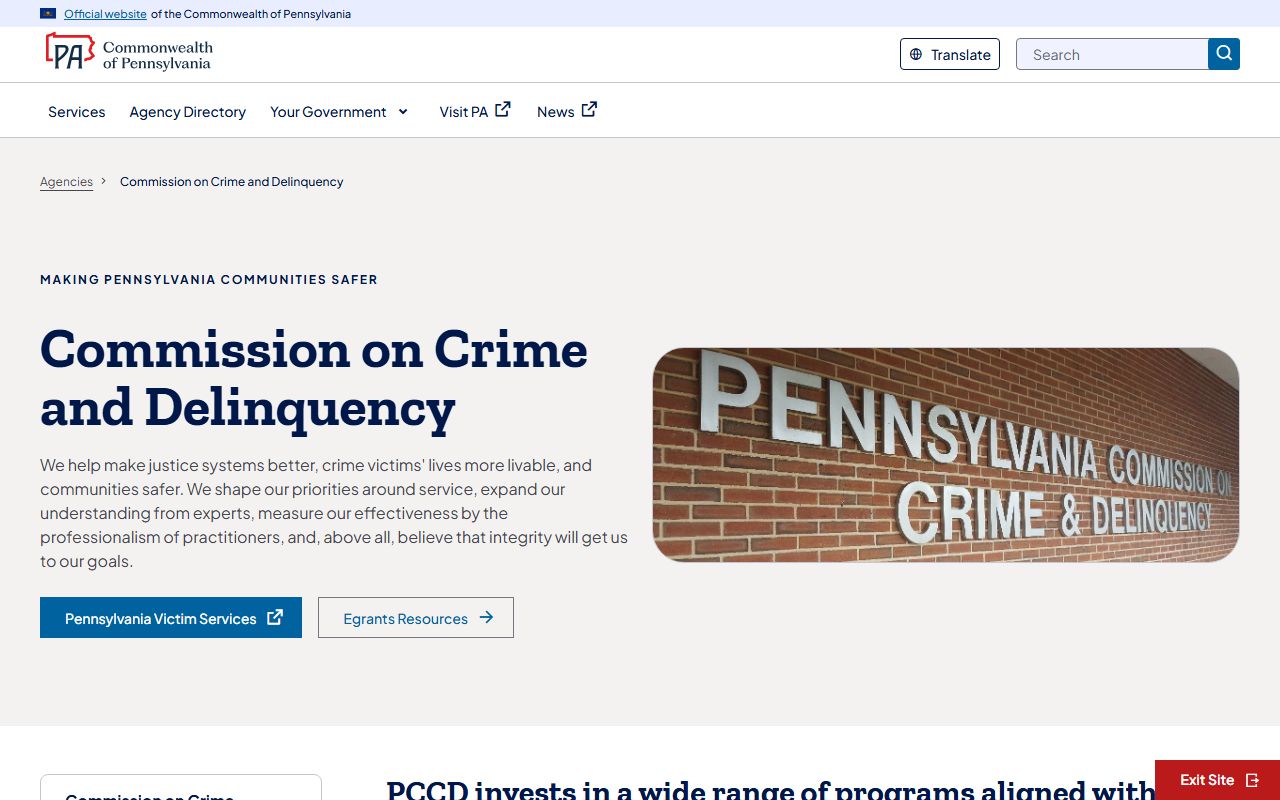
The PCCD homepage provides access to crime statistics, grant programs, victim services resources, and research publications for Pennsylvania criminal justice professionals and the public.
PCCD distributes federal Bureau of Justice Assistance grants to local agencies across Pennsylvania. It also manages the Protection From Abuse Database (PFAD), a statewide registry of protection orders available to law enforcement. PCCD publishes annual crime reports and recidivism studies that are available on their website. Contact the Commission at 3101 North Front Street, Harrisburg, PA 17110, phone 717-737-8724. To reach VCAP directly, call 800-233-2339.
Clean Slate and Expungement of Pennsylvania Criminal Records
Pennsylvania was the first state in the country to pass automatic record sealing legislation. Act 56 of 2018, known as the Clean Slate Law, seals eligible records without any petition or court appearance. Act 83 of 2020 expanded Clean Slate to cover more misdemeanor convictions. HB 689, signed December 14, 2023 and effective February 12, 2024, further expanded automatic sealing to additional offense categories.
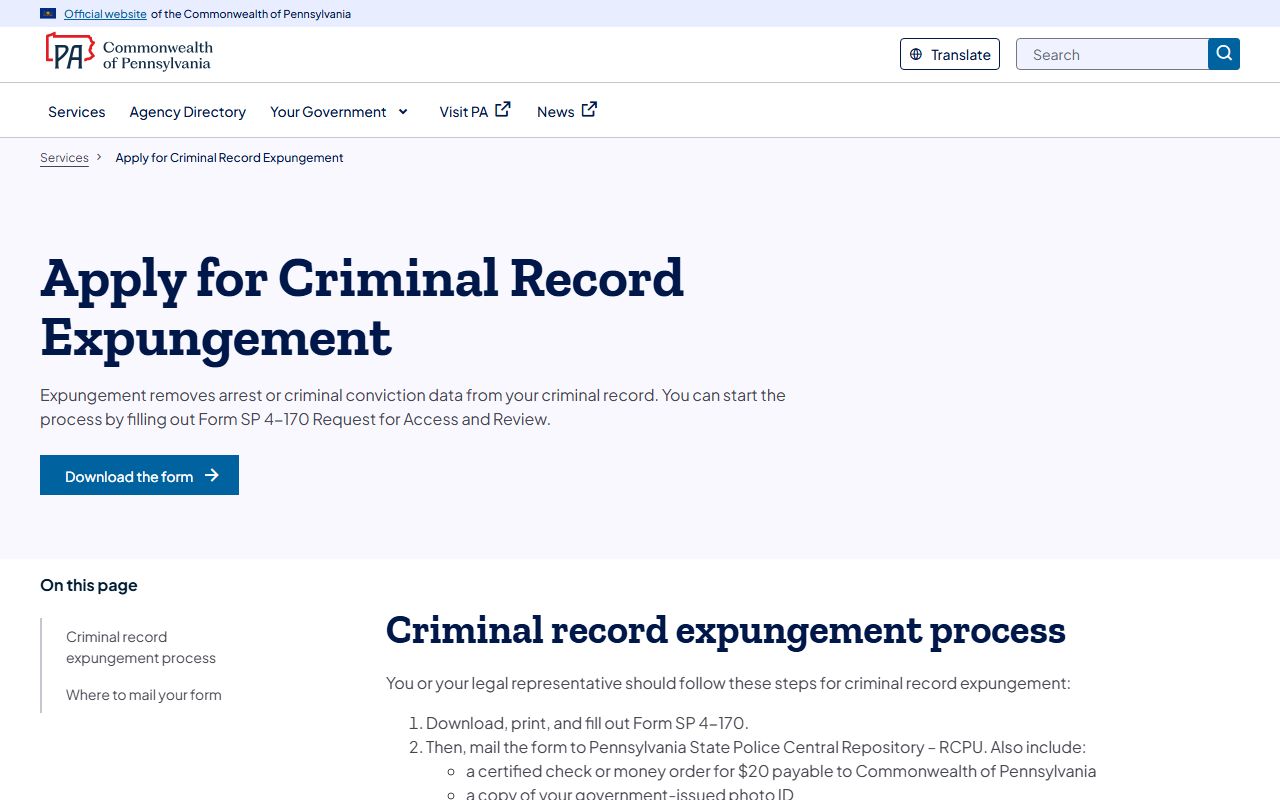
The PA.gov expungement page covers both automatic Clean Slate sealing and the petition-based expungement process under 18 Pa.C.S. § 9122 for eligible Pennsylvania criminal records.
Records sealed automatically under Clean Slate include summary offenses after 5 years, misdemeanor convictions with sentences under two years after 7 years, and second and third-degree felonies with sentences under seven years after 10 years. Charges not resulting in conviction are sealed after 60 days. ARD completions are sealed immediately upon finishing the program. All financial obligations must be paid and the person must remain conviction-free during the waiting period. First-degree felonies, murder, sex offenses requiring Megan's Law registration, crimes against minors, and domestic violence offenses are excluded from Clean Slate.
Sealed records still exist but are restricted from public access. Law enforcement, courts, and certain licensing boards retain access. You can check whether your records have been sealed by searching your name on the UJS Portal. Sealed cases will not appear in public results. For records that qualify but were not automatically sealed, you may petition under 18 Pa.C.S. § 9122.1 for limited access sealing.
Pennsylvania CHRIA and Criminal History Information Rights
The Criminal History Record Information Act (CHRIA), found at 18 Pa.C.S. Chapter 91, governs how criminal records are collected, stored, and shared in Pennsylvania. The law was adopted in January 1980 and applies to every person and agency that handles criminal history data in the state. The Pennsylvania Office of Attorney General oversees CHRIA compliance and publishes the CHRIA Handbook for reference.
Under CHRIA, individuals have the right to review their own criminal history records, challenge inaccurate information, and request corrections. Agencies have 60 days to respond to a challenge. If the challenge is denied, you can appeal to the Attorney General within 30 days, and then to Commonwealth Court within another 30 days. Felony records are kept permanently. Misdemeanor records are kept for 20 years. Summary offense records are kept for five years. Expunged records are removed from the repository. Unauthorized dissemination of criminal history information is a misdemeanor under CHRIA, and civil penalties of up to $1,000 per violation may apply.
Fingerprint-Based Pennsylvania Criminal Records Requests
Pennsylvania offers fingerprint-based criminal history checks through IDEMIA, which runs the IdentoGO service network. Fingerprint checks are more precise than name-based searches because they use biometric data to verify identity. Register for an appointment at uenroll.identogo.com. Locations are available throughout Pennsylvania and nationwide. The cost is $25.25 per session. Results come back within 7 to 14 business days and are sent directly to the applicant.
The IdentoGO portal at uenroll.identogo.com handles fingerprint appointment scheduling across Pennsylvania. Bring a valid government-issued photo ID to your appointment.
Individuals who want to review their own complete criminal record can do so through the Individual Access and Review process using Form SP 4-170. This process requires submitting fingerprints by mail along with a $20 fee to verify your identity. The result shows exactly what the Pennsylvania State Police Central Repository has on file for you. This is the most thorough way to review your own Pennsylvania criminal history record.
Pennsylvania Child Abuse History and Criminal Records
The Pennsylvania DHS Child Abuse Clearances system maintains a separate database from the PATCH criminal history system. Child abuse clearances search the ChildLine registry, which records substantiated findings of child abuse by Pennsylvania protective services. These records are distinct from criminal court records and are maintained by the Department of Human Services rather than the State Police.
The DHS Child Abuse Clearances page at dhs.pa.gov provides access to the ChildLine registry search system and explains how child abuse history records are maintained in Pennsylvania.
The Pennsylvania State Archives also holds historical criminal justice records dating back to the 18th century. The Archives at digitalarchives.state.pa.us contains inmate registers from Eastern State Penitentiary dating to 1829, Western State Penitentiary records from 1869, and court records from the colonial era. Researchers can access finding aids online before visiting in person. The Archives is open Tuesday through Friday 8:30 AM to 4:00 PM and Saturday 9:00 AM to 12:00 PM at 1681 North Sixth Street, Harrisburg.
Pennsylvania Courts and Criminal Case Records
The Pennsylvania Courts website at pacourts.us is the central resource for the state court system. Pennsylvania courts handle criminal cases at the Magisterial District Court level for summary offenses and preliminary hearings, and at the Court of Common Pleas for felonies and serious misdemeanors. Each of the 67 counties has its own Court of Common Pleas with a Clerk of Courts office that maintains criminal case files.
The Pennsylvania Courts homepage links to court rules, forms, opinions, and the UJS Portal for searching criminal and civil case records across all 67 counties of Pennsylvania.
Criminal record retention in Pennsylvania varies by offense type. Felony cases are retained permanently. Misdemeanor cases are retained for 20 years after case closure. Summary offenses are retained for three to seven years after disposition. Courts of Common Pleas charge their own fees for copies. Most offices charge $0.25 per page for standard copies and more for certified copies. Some courts accept mail requests for copies. You will need the party's name or case number to start a search at any Clerk of Courts office.
The following are the key Pennsylvania criminal records systems covered on this page:
- PATCH - certified criminal history checks from the Pennsylvania State Police
- UJS Portal - free court case search covering all levels of the Pennsylvania courts
- DOC Inmate Locator - daily-updated search for state prison inmates and parolees
- Megan's Law Registry - free public search of registered sex offenders by location
- Office of Open Records - appeals and guidance for Right-to-Know Law requests
- Board of Pardons - clemency applications and public hearing schedules
- Clean Slate / Expungement - automatic and petition-based record sealing options
Note: Records from federal courts, other states, or tribal courts do not appear in any Pennsylvania state system.
Pennsylvania Criminal Records by County
Each of Pennsylvania's 67 counties has its own Court of Common Pleas, Clerk of Courts, and Sheriff's office that all play a role in maintaining local criminal records. Pick a county below to find contact details, local offices, and resources for criminal records in that area.
Criminal Records in Major Pennsylvania Cities
Residents of Pennsylvania's largest cities file criminal cases at their county courthouse. Select a city below to find local resources, police record request forms, and court information for criminal records in that area.