
Philadelphia Criminal Records
Philadelphia criminal records are maintained by the First Judicial District of Pennsylvania and the Philadelphia Police Department. Philadelphia is a consolidated city-county with about 1.6 million residents, making it the largest city in the state. Criminal court records for felonies and serious misdemeanors are held at the Criminal Justice Center, while the Philadelphia Police Department handles requests for police reports and incident records. Searching Philadelphia criminal records can be done online through the UJS Portal or in person at city offices.
Philadelphia Quick Facts
How to Search Philadelphia Criminal Records
Searching criminal records in Philadelphia starts with the Pennsylvania Unified Judicial System Portal. The UJS Portal at ujsportal.pacourts.us gives free public access to criminal dockets for all court levels in the state, including every Philadelphia case. You can search by a person's name, docket number, or Offense Tracking Number. Results show charges filed, hearing dates, dispositions, and sentencing information.
Philadelphia operates the First Judicial District, which includes the Court of Common Pleas Criminal Division and Philadelphia Municipal Court. The Criminal Division at the Criminal Justice Center, 1301 Filbert Street, handles all felony cases. Municipal Court handles preliminary hearings and summary offenses. Public access terminals are available at the Criminal Justice Center and at City Hall for those who prefer to search in person at no cost.
The Philadelphia Courts website at courts.phila.gov provides case information, court schedules, and guidance on accessing records. The city also maintains a Criminal Records Center at City Hall, Room 170, where staff can assist with requests and provide certified copies of court documents.
Note: Expunged records, sealed records under Clean Slate, and juvenile records are not available through public portals.
Philadelphia Police Department Records
The Philadelphia Police Department Right-to-Know page provides forms and instructions for requesting police reports, incident records, and related documents. The Records Unit is located at 750 Race Street, Philadelphia, PA 19106, and can be reached at 215-686-3053.
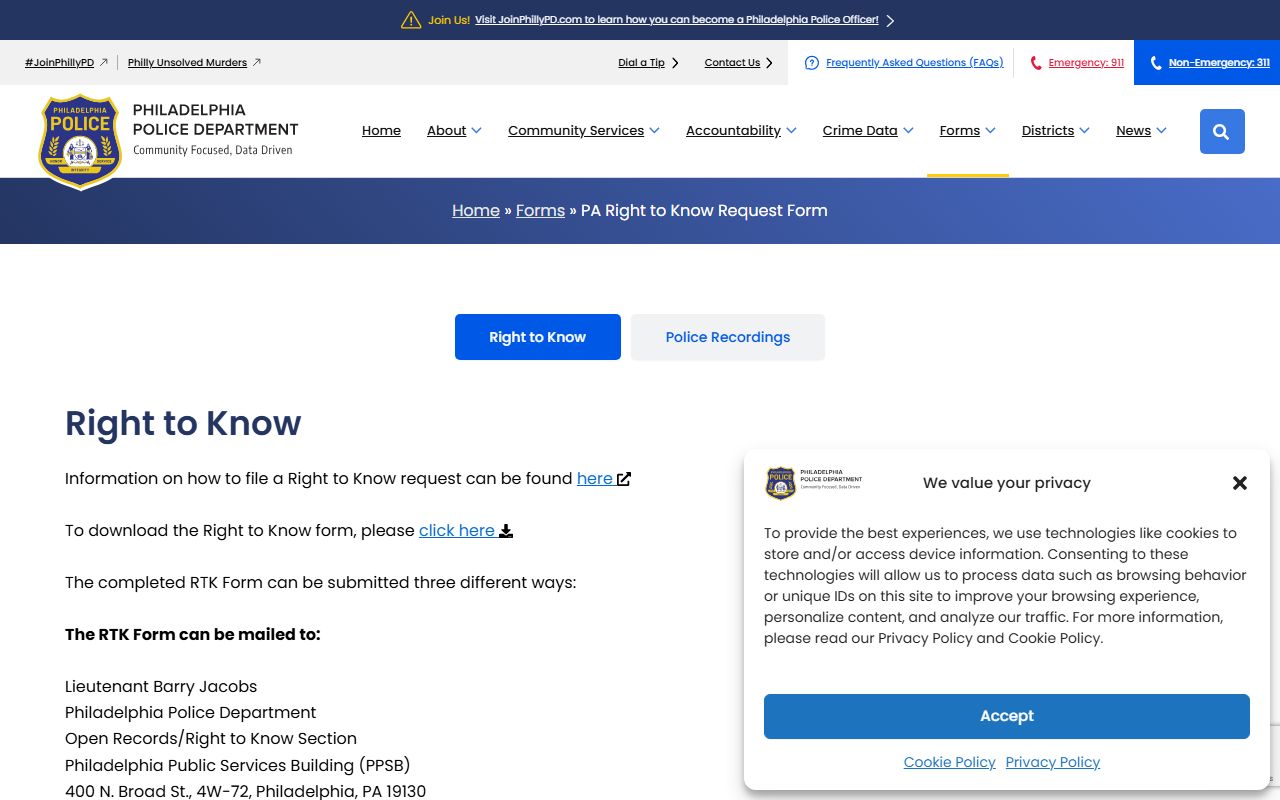
Requests go through the Right-to-Know Law process for most records. Philadelphia follows the Pennsylvania Right-to-Know Law (65 P.S. § 67.101), which gives the public a legal right to access government records including police reports. Standard requests take 10 to 15 business days. Reports for ongoing investigations may be withheld until the case is closed. Office hours are Monday through Friday, 8:00 AM to 4:00 PM.
Body camera and dashboard camera footage can be requested under Act 22 of 2017, which applies to all Pennsylvania law enforcement agencies. A separate request form is required for Act 22 video footage. Fees are based on the time required to process and redact the footage. Motor vehicle accident reports are available through the Philadelphia Crash Reports portal at crashreports.phila.gov, which is a faster option than the main Records Unit for accident-only requests.
Philadelphia Court System and Criminal Dockets
Philadelphia runs a specialized court structure unlike most Pennsylvania counties. The First Judicial District includes several divisions that each handle different criminal matters. The Criminal Division at the Criminal Justice Center processes all felony cases and serious misdemeanor charges in Philadelphia. Municipal Court handles preliminary hearings, summary offenses, and minor charges. Philadelphia also operates a Treatment Court, Mental Health Court, and Veterans Court as part of its problem-solving court programs.
Criminal dockets in Philadelphia use the standard Pennsylvania format: CP-51-CR-XXXXXXX-YYYY. The county code for Philadelphia is 51. You can use this number directly in the UJS Portal to pull up any specific case. Docket entries show every step of the case from arraignment through sentencing and any post-conviction motions filed. Historical records at the Philadelphia Courts date to the 1680s, with older documents held at the City Archives.
The CJIS portal through the courts.phila.gov website gives additional case detail for Philadelphia criminal matters. Attorneys and court staff have expanded access. Public users can view case status, party names, charge descriptions, and court dates through the standard public interface at no charge.
Background Checks for Philadelphia Residents
Philadelphia residents who need a formal criminal background check use the Pennsylvania Access to Criminal History system, known as PATCH. PATCH is the official state criminal history portal run by the Pennsylvania State Police. You can access it at epatch.pa.gov. A standard criminal history check costs $22. Notarized copies cost an additional $5 for a total of $27. Volunteer checks are free using Form SP 4-164A.
PATCH covers all Pennsylvania law enforcement records. It does not include federal records or records from other states. Results for cases with no record come back immediately in most cases. When a record is found, the response is mailed to the requester after manual review, which can take up to two to four weeks.
Philadelphia residents who need to verify their own criminal history can submit Form SP 4-170 by mail with a fingerprint card to receive a full PATCH report. For court-certified records of specific Philadelphia cases, visit the Criminal Records Center at City Hall, Room 170, or contact the Philadelphia Courts clerk services through courts.phila.gov. Certified docket copies and official disposition records are available for licensing applications, legal proceedings, and personal record review.
Expungement and Record Sealing in Philadelphia
Philadelphia residents with criminal records may be able to have those records expunged or sealed. Pennsylvania law provides two main paths. The first is a standard petition for expungement under 18 Pa.C.S. § 9122, which applies to cases that were dismissed, charges that were withdrawn, or situations where the person completed an ARD program and met the waiting period. The second path is Clean Slate, which provides automatic sealing for eligible records without a court petition.
Clean Slate sealing applies to non-conviction records and to certain misdemeanor convictions after a ten-year conviction-free period, provided all fines and costs have been paid. Once records are sealed under Clean Slate, they do not appear on standard public searches or PATCH checks. Philadelphia courts process Clean Slate sealing quarterly. Felony convictions generally do not qualify unless specific criteria under the law are met.
To file a petition for expungement in Philadelphia, you submit it through the Criminal Division at the Criminal Justice Center. The court has a fee schedule for expungement petitions. Pennsylvania Legal Aid and other nonprofit organizations in Philadelphia can assist low-income residents with the expungement process at little or no cost.
Note: More information on expungement eligibility is available through the state at the Pennsylvania expungement information page.
City of Philadelphia Records and Open Data
The City of Philadelphia portal at phila.gov connects residents to a wide range of public records resources. The Open Records Office handles formal Right-to-Know Law requests for city records. Appeals from denied police report requests go to this office within 15 business days of denial. The city also publishes crime statistics and public safety data through Philly Stat 360 and the OpenDataPhilly platform.

Philadelphia criminal case information is also searchable through public data portals. The city posts aggregate crime data by neighborhood and type, which helps residents understand local crime trends. This data is different from individual criminal records and does not include personal identifying information about defendants.
What Philadelphia Criminal Records Show
A Philadelphia criminal court docket contains a detailed history of the case from first charge through final disposition. Key elements include the defendant's name and date of birth, all charges with Pennsylvania Crimes Code citations, arrest date, bail information, hearing dates, and the names of the assigned judge and attorneys. The docket also shows the final outcome, including whether the case ended in conviction, acquittal, dismissal, or ARD diversion.
If the defendant was convicted and sentenced, the docket includes the sentence details. Incarceration terms show both the minimum and maximum dates. Probation terms list the length and conditions. Financial obligations including fines, court costs, and restitution are shown separately. The OTN (Offense Tracking Number) allows the case to be tracked across the criminal justice system, from the police department through the courts and corrections.
Police reports from the Philadelphia Police Department contain incident details, party information, officer observations, and preliminary findings. These are separate from court dockets and must be requested directly from the PPD Records Unit. Police reports for active investigations are generally not released until the case is resolved.
- Charges with Crimes Code statutory citations
- Arrest date and arresting officer
- All court hearings and their outcomes
- Final disposition (guilty, dismissed, ARD, etc.)
- Sentencing details including probation and fines
- Financial obligations and payment history
Philadelphia County Criminal Records
Philadelphia city and Philadelphia County are the same jurisdiction. All criminal court filings for the city go through the Philadelphia County Court of Common Pleas under the First Judicial District. For more details on the county court system, records access, expungement resources, and related information, visit the Philadelphia County criminal records page.
Nearby Pennsylvania Cities
Residents of nearby cities access criminal records through their own county courts and local police departments. Select a city below to find criminal records information in that area.